How to Add Sources to Your Family Tree
Adding names to your family tree is exciting. Adding sources is what keeps your tree from turning into a beautiful but slightly suspicious guessing machine.
A source is simply the record, document, photo, book, website, or other piece of evidence that tells you where a family tree fact came from. Sources help you remember why you added a person, date, place, or relationship in the first place.
Think of sources as the receipts for your genealogy research. And in family history, keeping the receipts matters. Especially when three people named John Miller are all trying to sneak into the same branch.
What Is a Source in Genealogy?
A genealogy source is anything that gives you information about your family. It helps support the facts in your tree.
Sources can include:
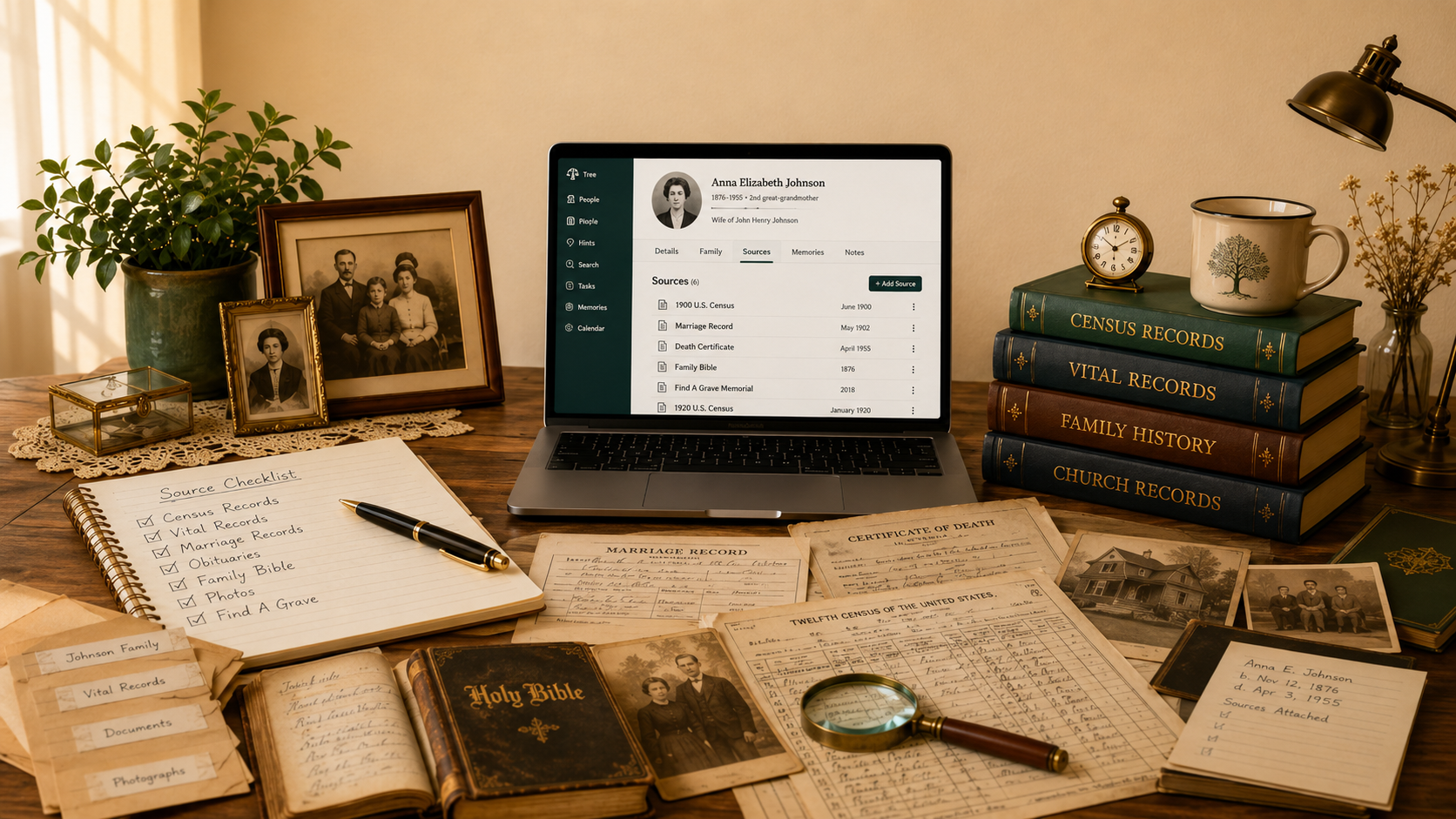
- Census records
- Birth certificates
- Marriage records
- Death certificates
- Obituaries
- Gravestones
- Church records
- Military records
- Immigration records
- Newspaper articles
- Family Bibles
- Old letters or photographs
- Family stories or interviews
Some sources are official records. Some are family memories. Some are clues that still need checking. The important thing is to write down where the information came from.
Why Sources Matter
Sources help you build a stronger family tree. Without them, it can be hard to tell whether a detail is proven, guessed, copied from another tree, or added during a late-night genealogy adventure when everything looked possible.
Sources help you:
- Find the same record again later
- Check whether a fact is reliable
- Compare conflicting information
- Avoid adding the wrong person
- Show others where your information came from
- Fix mistakes when new clues appear
A source does not always prove everything by itself, but it gives you a place to start. It is much better than staring at your tree later and wondering, “Where on earth did I get that birth date?”
Start With the Fact You Want to Support
When adding a source, first ask yourself what fact the source supports.
For example, a census record might support:
- A person’s name
- An estimated birth year
- A birthplace
- A spouse’s name
- Children in the household
- A residence in a certain year
- An occupation
A marriage record might support:
- A marriage date
- A marriage place
- A spouse’s name
- Parents’ names, if listed
- Witness names
You do not need to make this complicated. Just notice what the record actually says. Do not make the source do more work than it can handle. A census record may suggest a birth year, but it usually does not prove an exact birth date.
Add the Source to the Correct Person
This sounds obvious, but it matters. Before saving a source, make sure it belongs to the correct person in your tree.
Ask:
- Does the name match or make sense?
- Is the age close?
- Is the location reasonable?
- Do the family members match?
- Does the record fit with other records?
- Could this be someone else with the same name?
If the record might be your ancestor but you are not sure, do not treat it as proven. Save it as a possible clue or make a note explaining your uncertainty.
Genealogy is much easier when your sources are attached to the right people. Wild concept, I know.
What Information Should You Save?
You do not need to write a perfect academic citation to get started. Beginner-friendly source notes are perfectly fine, as long as they help you find the record again and understand why you saved it.
Try to save:
- The name of the record or collection
- The person the record is about
- The date or year of the record
- The place connected to the record
- The website, archive, book, or location where you found it
- A link, image, page number, or record ID if available
- A short note about what the record tells you
A simple note is better than no note.
1900 U.S. census for James Wilson household, Erie County, New York. Shows James with wife Mary and children Anna, Robert, and Clara. Found on FamilySearch.
That may not win a citation beauty contest, but it gives you something useful to work with.
Use Notes When a Source Is Confusing
Sometimes a source gives helpful information, but it also creates questions. Maybe the age is off. Maybe the birthplace is different. Maybe the name is spelled oddly. Maybe the handwriting looks like a spider fell into an ink bottle.
This is where notes help.
You might write:
This may be the correct Sarah Miller. Husband and children match later records, but her birthplace is listed as Pennsylvania instead of New York. More research needed.
Notes like this are valuable because they explain your thinking. They also keep you from accidentally treating a maybe-clue like a proven fact.
Attach Sources to Relationships Too
Sources do not only support names and dates. They can also support relationships.
For example, if a birth record names a child’s parents, that source supports the parent-child relationship. If a marriage record names a bride and groom, that source supports the marriage.
This is especially important when building earlier generations. A person’s name and date are useful, but proving how they connect to the next generation is the real key.
Look for records that directly connect people, such as:
- Birth records naming parents
- Marriage records naming spouses or parents
- Death certificates naming parents or spouse
- Obituaries naming relatives
- Wills naming children or heirs
- Census records showing household members
- Church records naming family relationships
Do not just ask, “Do I have a name?” Ask, “Do I have a source showing how this person fits into the family?”
Do Not Use Online Trees as Your Only Source
Online family trees can be helpful, but they should not be your only source for important facts.
Another person’s tree may point you toward a record, a surname, or a place to investigate. That is useful. But the tree itself may contain mistakes, copied guesses, or family connections that were never proven.
If you find information in an online tree, ask:
- Does the tree have sources attached?
- Do those sources actually support the information?
- Can I find the original record?
- Does this fit with what I already know?
Online trees are clues. Original records are better. Your family tree deserves more than “someone on the internet said so,” even if that someone used capital letters with confidence.
Save Record Images When You Can
If a website allows you to download or save the record image, it is a good idea to keep a copy for your own files.
Save the image with a clear file name, such as:
1910-census-william-brown-erie-county-ny.png
This is much better than:
image_983742_final_realfinal.png
Clear file names help you find records again without needing a search party and a snack.
What If Two Sources Disagree?
Sooner or later, two sources will disagree. One record says your ancestor was born in 1852. Another says 1855. One says New York. Another says Pennsylvania.
This is normal.
When sources disagree, do not automatically delete one. Compare them.
Ask:
- Which record was created closest to the event?
- Who likely gave the information?
- Was the person reporting their own details or someone else’s?
- Does the information match other records?
- Could one record belong to a different person?
Keep both sources if they may be useful, and add a note explaining the conflict.
Census records suggest a birth year between 1852 and 1855. No birth record has been found yet.
That is honest, clear, and much better than forcing one record to behave.
Make Source-Adding a Habit
The easiest way to keep your tree organized is to add sources as you go. Do not wait until later.
A simple habit might be:
- Find a record.
- Check that it belongs to the right person.
- Add the fact or clue to your tree.
- Add the source.
- Write a short note if anything is uncertain.
This may feel slower at first, but it saves time later. Unsourced trees can become confusing very quickly, and nobody wants to spend a weekend asking, “Why did I think this man’s mother was named Margaret?”
Final Thoughts
Adding sources to your family tree is one of the best habits you can build as a beginner. Sources help you remember where information came from, check your work, compare records, and avoid attaching the wrong people.
You do not need to be perfect. Start simple. Save the record name, where you found it, what it says, and why it matters.
A family tree with sources is stronger, clearer, and much easier to trust. It also saves future-you from muttering at the computer, which is a noble genealogy goal.