How to Use Ancestry Hints Without Letting Them Boss You Around
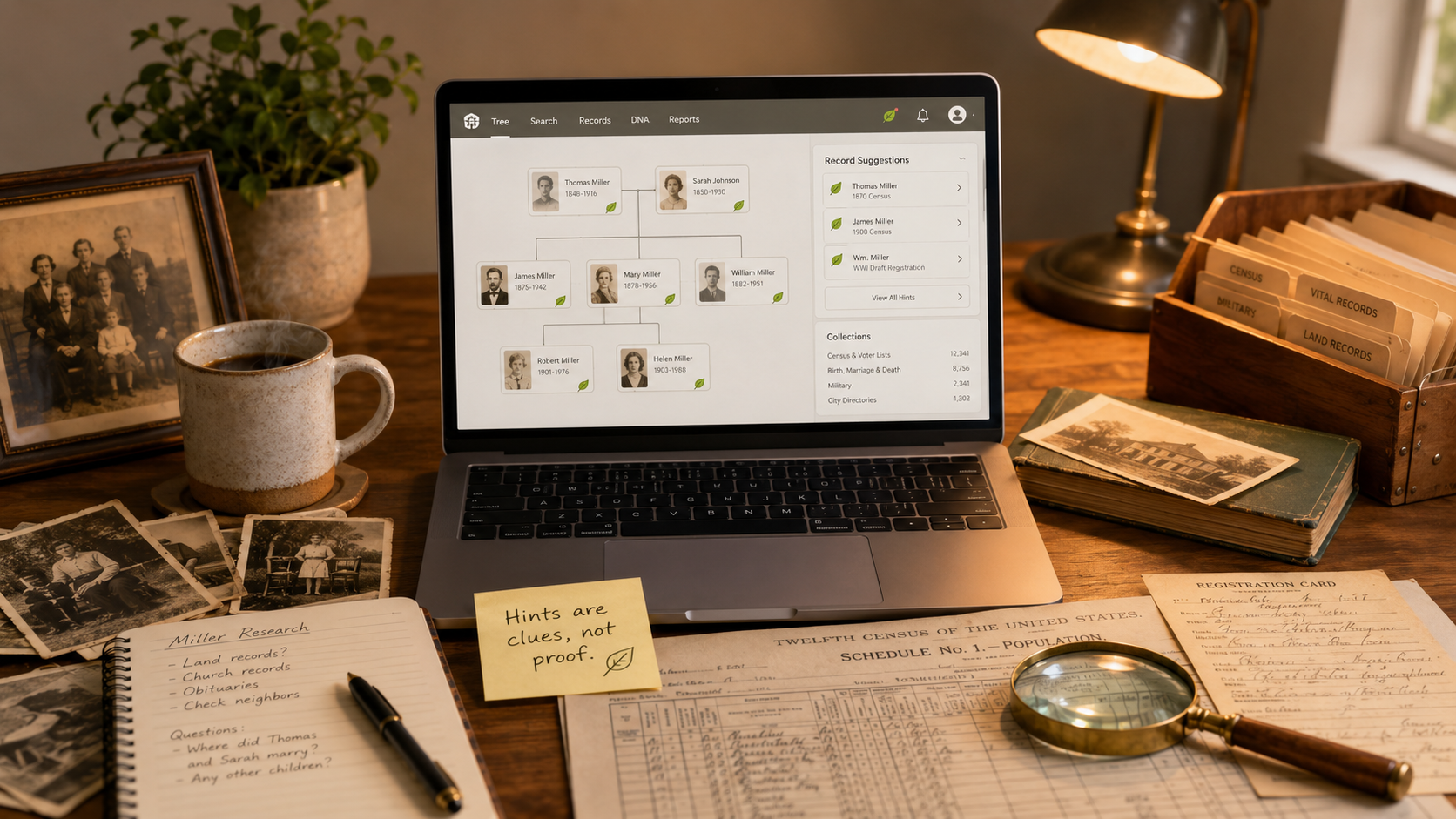
Ancestry hints can feel very exciting when you are building your family tree. A little green leaf appears, and suddenly it feels like your ancestor has sent you a message from the past saying, “Click this immediately.”
But here is the important part: an Ancestry hint is not proof. It is a suggestion. Sometimes it is wonderfully helpful. Sometimes it is close but not quite right. And sometimes it is confidently wrong, which is honestly a little rude.
This guide will help you use Ancestry hints wisely, so they help your family tree instead of leading it into the genealogy weeds.
What Are Ancestry Hints?
Ancestry hints are record suggestions that Ancestry finds based on the information in your family tree. If you have a person named John Miller born around 1850 in Pennsylvania, Ancestry may search its records and suggest census records, marriage records, death records, military records, family trees, photos, or other documents that might match him.
The keyword here is might.
Hints are helpful because they can point you toward records you may not have found on your own. But they still need to be checked carefully before you add them to your tree.
Start With What You Already Know
Before accepting a hint, look at what you already know about the person in your tree.
Ask yourself:
- What was their full name?
- When were they born?
- Where were they born?
- Who were their parents, spouse, or children?
- Where did they live during their life?
The more you know, the easier it is to tell whether a hint fits. If the hint is for someone with the same name but the wrong state, wrong spouse, or wrong children, slow down. Same name does not always mean same person.
Open the Hint and Read the Details
It is tempting to click “Accept” quickly, especially when you have a lot of hints waiting. But before you add anything, open the hint and read the record details.
Look for names, dates, places, family members, occupations, and anything else that helps connect the record to your ancestor.
For example, a census record might include your ancestor’s spouse and children. A death record might name parents. A marriage record might give a spouse, date, location, or witness. These details matter because they help you decide whether the record truly belongs to your person.
Compare the Hint to Your Tree
Once you open a hint, compare it against the person in your tree. Do not just compare one detail. Compare several details together.
A good hint usually matches more than one thing, such as:
- Name
- Approximate birth year
- Location
- Spouse
- Children
- Parents
- Known timeline
If the name matches but everything else feels suspicious, do not force it. Genealogy has enough mystery without inviting the wrong John Smith to dinner.
Be Extra Careful With Other People’s Family Trees
Ancestry may show hints from other members’ family trees. These can be useful for ideas, but they should be handled carefully.
Other trees may contain correct information, but they can also contain copied mistakes. One wrong parent can be copied into dozens of trees, and suddenly it looks official just because it appears everywhere.
Use other family trees as leads, not proof. If another tree gives you a new name, date, or place, look for records that support it before adding it as fact.
In other words, other trees can point you toward the trail, but they should not drive the car.
Check the Original Image When You Can
Whenever possible, look at the original record image, not just the typed summary. Transcriptions are helpful, but they are not perfect.
Names can be misread. Dates can be entered incorrectly. Places can be shortened or misunderstood. Sometimes the original image includes extra information that does not appear in the index.
When you look at the image yourself, you may notice details like neighbors, witnesses, household members, occupations, or notes in the margins. These little clues can be very useful.
Do Not Accept a Hint Just Because It Looks Close
Some hints look close enough at first glance. The name is right. The age is almost right. The location is nearby. That can be promising, but it still needs checking.
People with the same name often lived in the same area, especially in large families or small towns. Cousins, fathers, sons, and neighbors may share names. This is one reason genealogy can feel like everyone attended the same naming meeting and agreed to be difficult.
Before accepting a close match, ask:
- Does the age make sense?
- Does the location fit the person’s timeline?
- Does the spouse or household match?
- Does this record conflict with something I already know?
- Could this be a different person with the same name?
Watch Out for Timeline Problems
A timeline problem happens when a record does not fit with the rest of a person’s life.
For example, if your ancestor lived in Ohio in 1880, had children in Ohio in 1882 and 1885, and then a hint places them in England in 1883, that needs a closer look. It may still be possible, but it should not be accepted without more evidence.
Dates and places do not have to match perfectly every time. Records often contain mistakes. But the overall story should make sense.
If a hint creates a strange jump in your ancestor’s life, pause before adding it.
Use “Maybe” When You Are Not Sure
You do not have to accept or reject every hint immediately. If something looks possible but you are not sure, leave it for later or make a note about it.
You might write something like:
Possible match, but needs more proof. Name and age are close, but spouse does not match known records.
This keeps the clue from disappearing while also reminding future-you not to treat it as proven. Future-you will appreciate this. Future-you is already busy.
Accept the Hint Carefully
When you do decide a hint belongs to your ancestor, add it carefully. Read each field before saving it to your tree.
Sometimes Ancestry will suggest adding new facts, names, dates, or places. Do not automatically accept every change. Make sure the new information is truly supported by the record.
For example, a record may show an estimated birth year based on age. That does not always mean you should replace a more exact birth date you already have from a stronger source.
Reject Hints That Clearly Do Not Fit
It is okay to reject hints. In fact, it is a good habit.
If a hint is clearly for the wrong person, reject it so it does not keep distracting you. This helps keep your workspace cleaner and makes it easier to focus on better clues.
Rejecting a hint does not mean you are being mean to the leaf. The leaf will survive.
Keep Notes on Tricky Hints
Some hints are not clearly right or wrong. These are the tricky ones.
For confusing hints, keep a short note explaining what you found. You can mention why the record might fit, why it might not, and what you still need to check.
Good notes can save you from re-checking the same confusing record six months later and saying, “Why did I look at this again?” We have all been there. The ancestors know.
A Simple Hint-Checking Routine
Here is an easy routine you can use before accepting an Ancestry hint:
- Open the hint.
- Read the record details.
- Look at the original image if available.
- Compare the name, date, place, and family members.
- Check whether it fits the person’s timeline.
- Decide whether to accept, reject, or save it for later.
- Add a note if the hint is uncertain.
This routine may take a little longer than clicking accept right away, but it helps protect your tree from mistakes.
Final Thoughts
Ancestry hints can be incredibly useful. They can lead you to records, family connections, and details you may not have found on your own. But they work best when you treat them as clues instead of answers.
Take your time. Compare the details. Check the original record when you can. Be careful with other people’s trees. And remember that you are the detective, not the little green leaf.
Your family tree does not have to be perfect overnight. It just needs to grow carefully, one good clue at a time.