
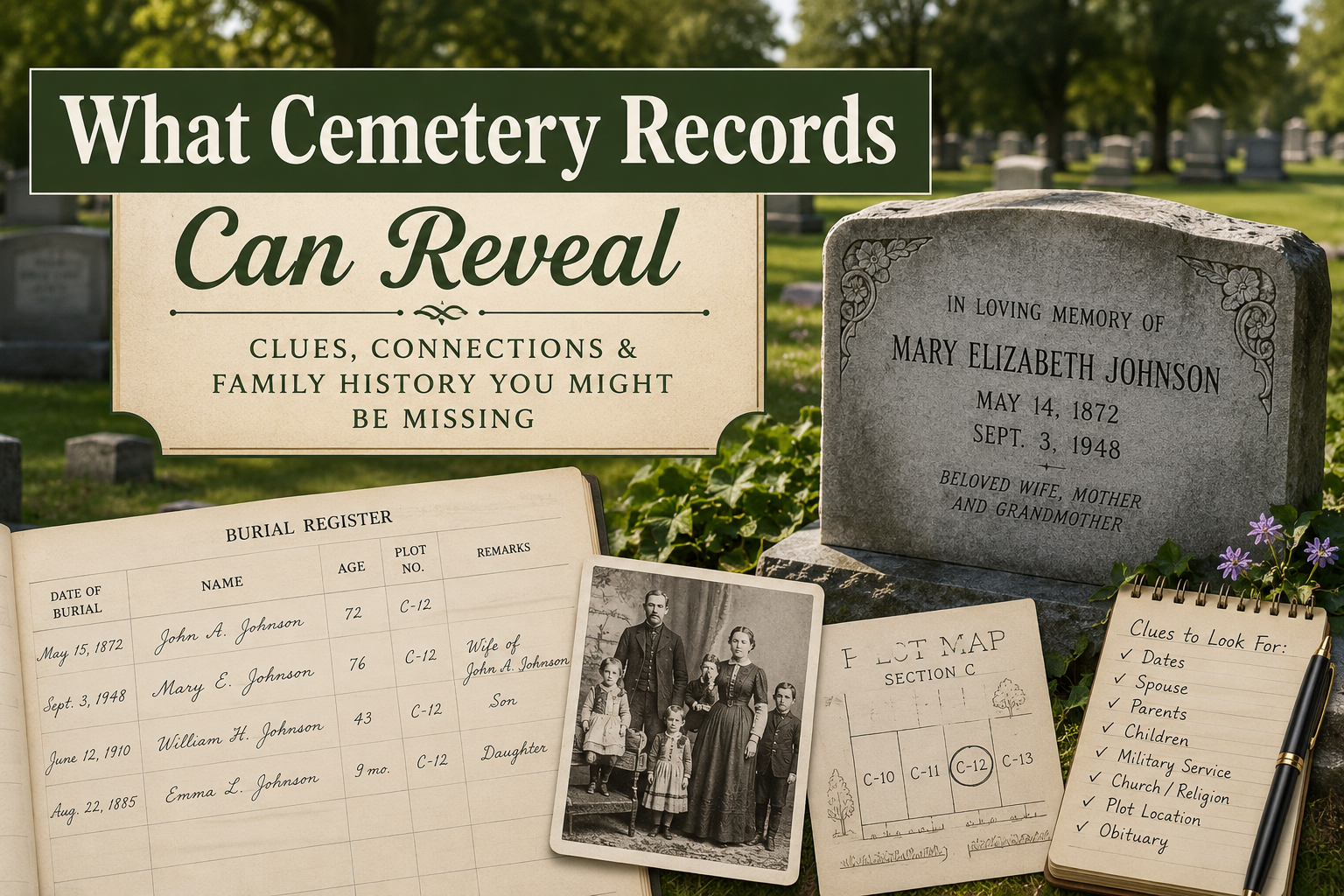
What Cemetery Records Can Reveal
Cemetery records can be surprisingly helpful in family history research. At first, they may seem like they only tell you where someone was buried, but they can reveal much more than that.
A cemetery record, gravestone, burial register, or cemetery plot map may give you dates, family connections, locations, religious clues, military service, maiden names, and even hints about relatives you did not know existed.
In other words, cemeteries are not just places of rest. For genealogists, they are also places where clues sit very quietly and wait for someone with a notebook and too many browser tabs.
What Are Cemetery Records?
Cemetery records are documents or details connected to a person’s burial. They may come from a cemetery office, church, town, funeral home, online memorial site, gravestone photo, burial register, or local historical society.
Depending on the place and time period, cemetery records may include:
- Name of the deceased
- Date of death
- Date of burial
- Age at death
- Burial location or plot number
- Names of relatives
- Funeral home information
- Church or religious affiliation
- Military service
Not every cemetery record includes all of these details. Some records are very detailed, while others are basically saying, “Here lies someone named John. Good luck.”
Dates of Birth and Death
One of the most obvious things a cemetery record or gravestone may reveal is a person’s birth and death information.
A gravestone might show a full birth date and death date, or it may only show years. Sometimes it gives an age at death, such as “aged 72 years, 4 months, 11 days.” That age can help you estimate a birth date.
But be careful. Gravestones can be wrong. Dates may have been remembered incorrectly, carved incorrectly, or added years after the person died.
If a cemetery record gives you a birth or death date, treat it as an important clue and look for other records to support it.
Family Members Buried Nearby
One of the best things cemetery research can reveal is family connections.
Relatives were often buried near each other. A spouse, child, parent, sibling, in-law, or even a second spouse may be buried in the same plot or nearby row.
If you find your ancestor in a cemetery, do not stop with that one person. Look at the surrounding graves and nearby memorials.
You may find:
- A spouse you did not know about
- Children who died young
- Parents or grandparents
- Married daughters with different surnames
- In-laws or stepfamily members
- Relatives with shared middle names
Sometimes the best clue is not on your ancestor’s stone. It is two stones over, minding its own business.
Maiden Names and Married Names
Cemetery records can sometimes help you find a woman’s maiden name or married name.
A gravestone may include wording such as “wife of,” “daughter of,” or “beloved mother of.” A burial record may list a parent, spouse, or next of kin. A family plot may include relatives with different surnames who help connect the family.
For example, if you find a woman buried near people with a different surname, that surname may be connected to her birth family, married children, or in-laws.
This does not prove the relationship by itself, but it gives you a lead to follow.
Children Who Died Young
Cemetery records may reveal children who do not appear in many other records.
In earlier time periods, some children died between census years and may only show up in burial records, church records, family Bibles, or gravestone inscriptions.
Finding these children can help explain gaps in a family timeline. It may also help you understand naming patterns, family movement, or why a later child was given the same name as an earlier child who died young.
These discoveries can be sad, but they are also part of the family’s story.
Military Service Clues
Some gravestones and cemetery records include military information.
You may see:
- War or conflict served in
- Military rank
- Regiment or unit
- Branch of service
- Veteran marker or flag holder
This can point you toward military records, pension files, service records, draft registrations, or veteran burial records.
If a cemetery record suggests military service, write down exactly what it says. Even small details like a regiment number can help you search more accurately.
Religious or Church Connections
The cemetery itself may give you clues about religion or community ties.
If your ancestor was buried in a church cemetery, that may suggest a connection to that church or denomination. This can lead you to baptism records, marriage records, burial registers, membership lists, or church histories.
Even a cemetery name can be useful. A burial in a Catholic, Lutheran, Baptist, Jewish, Quaker, or Methodist cemetery may point you toward specific religious records.
Location Clues
Where someone is buried can help you understand where they lived, where their family lived, or where they had important connections.
Sometimes a person is buried in the town where they died. Other times, they are buried in a family cemetery, a hometown, or near relatives.
If someone died in one place but was buried somewhere else, ask why. The answer may reveal family ties, migration patterns, land ownership, or earlier roots.
For example, if your ancestor died in a city but was buried in a small rural cemetery, that rural place may be connected to their parents, spouse, or childhood home.
Plot Numbers and Cemetery Maps
If you can find a cemetery plot number or map, do not ignore it. Plot information can help you identify who was buried together.
A cemetery office or burial register may show that several people were buried in the same lot. Even if they do not share the same last name, they may still be connected.
This can be especially helpful for:
- Married daughters
- Second marriages
- Stepfamilies
- In-laws
- Children who died young
- Parents living with adult children
A plot map can turn a single burial into a small family puzzle. A very quiet puzzle, but still.
Obituaries and Funeral Homes
Cemetery records may lead you to other helpful records, especially obituaries and funeral home records.
If a burial record names a funeral home, that can be a clue. Funeral home records may include next of kin, place of death, burial details, parents’ names, or informant information.
An obituary may list surviving relatives, married names of daughters, siblings, children, grandchildren, church memberships, military service, clubs, and places lived.
If you find a burial date, use it to search local newspapers around that time. Obituaries often appeared within a few days of death or burial.
Online Cemetery Sites
Websites like Find a Grave and BillionGraves can be useful for cemetery research. They may include gravestone photos, burial locations, family links, biographies, and cemetery details.
These websites are helpful, but they should be used carefully. Some information is added by volunteers or family researchers and may not be verified.
A gravestone photo is a stronger clue than an unsourced family link. A memorial biography may be useful, but you should still look for records that support the information.
Common Cemetery Research Mistakes
Cemetery records are useful, but there are a few common mistakes to avoid.
- Assuming every same-name burial is your ancestor
- Trusting unsourced online memorial details without checking
- Ignoring nearby graves
- Forgetting that gravestone dates can be wrong
- Missing women because their married names changed
- Not checking cemetery maps or plot records
A careful cemetery search looks at the person, the dates, the location, the nearby burials, and how everything fits with the rest of the family timeline.
A Simple Cemetery Record Checklist
When you find a cemetery record, ask these questions:
- What name is listed?
- What dates are given?
- Is there an age at death?
- Who is buried nearby?
- Is there a spouse, parent, or child listed?
- Is there military information?
- Does the cemetery suggest a church or religious connection?
- Is there a plot number or cemetery map?
- Can I find an obituary, death certificate, or funeral home record?
This checklist can help you slow down and collect more than just a name and date.
Final Thoughts
Cemetery records can reveal much more than a burial place. They can point you toward family relationships, maiden names, children, military service, church records, locations, obituaries, and new branches to explore.
Like all genealogy clues, cemetery records should be compared with other sources. But they are often a wonderful starting point, especially when you are trying to connect family members or understand where someone fits.
So the next time you find an ancestor’s burial, take a closer look. The gravestone may be quiet, but the clues can still have plenty to say.