
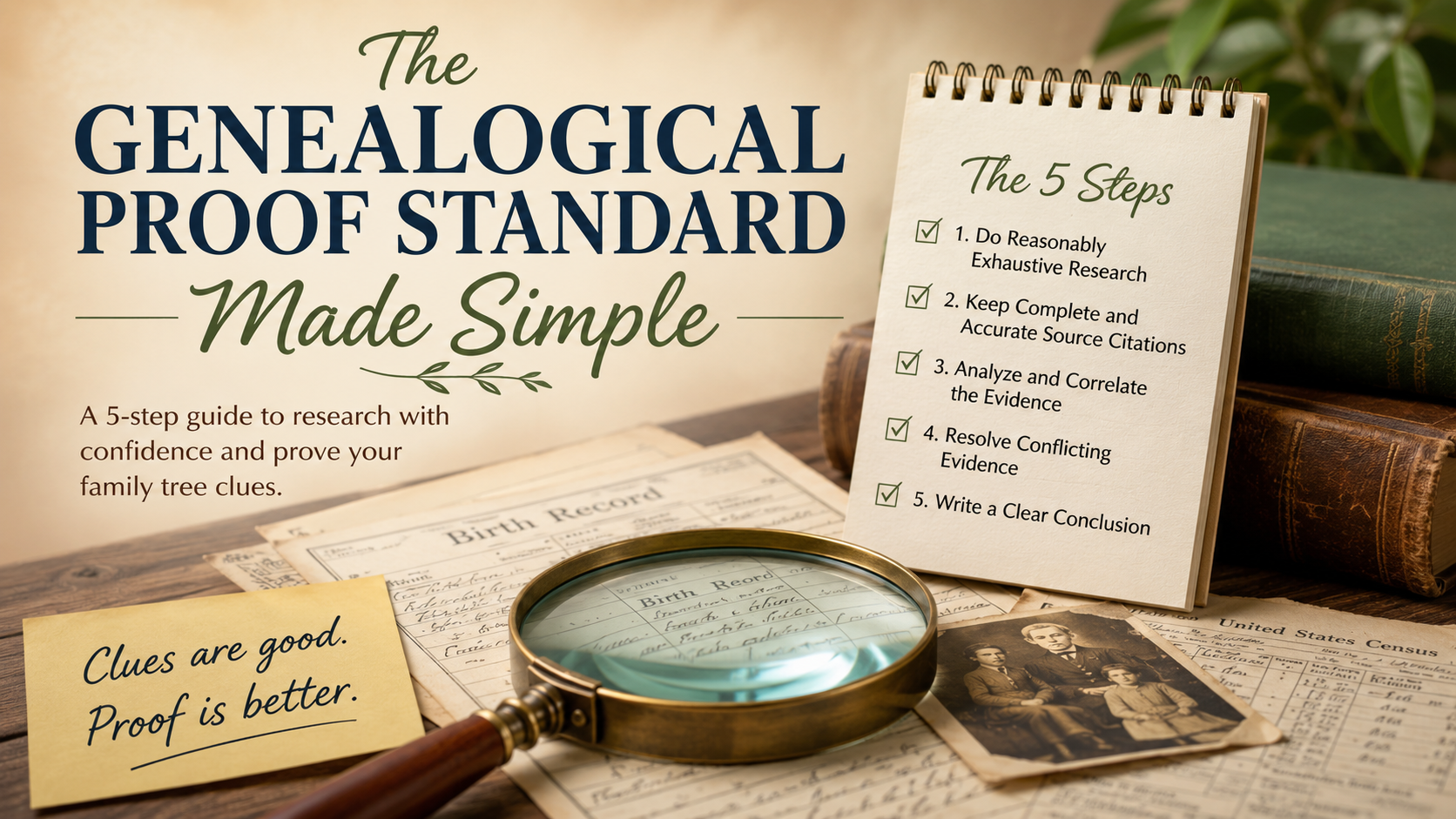
The Genealogical Proof Standard Made Simple
The Genealogical Proof Standard: How to Know If Your Family Tree Clue Is Actually Proven
When you are building a family tree, it is very easy to get excited.
You find a name. The dates look close. Someone else has that person in their tree. There is a shaky leaf practically waving at you like it knows something.
And before you know it, you have added a brand-new ancestor, three extra generations, and possibly a duke, a pirate, or a woman named “Unknown Wife” who somehow lived to be 147.
This is where the Genealogical Proof Standard, often called the GPS, comes in.
The Genealogical Proof Standard is a five-part process used by genealogists to decide whether a family tree conclusion is well supported. That may sound formal, but don’t panic. You do not need to be a professional genealogist to use the idea.
You can use it as a simple checklist before trusting a family tree clue.
What Is the Genealogical Proof Standard?
The Genealogical Proof Standard is a way to answer one very important question:
“Have I done enough research to trust this conclusion?”
It does not mean you found one record and called it done.
It means you looked for enough evidence, compared what you found, dealt with anything that did not match, and wrote down why you believe your answer is correct.
In plain English, it helps you avoid building your family tree on guesswork.
The Five Parts of the Genealogical Proof Standard
The GPS has five main parts. Here they are in normal people language.
1. Do Reasonably Exhaustive Research
This means you should look for more than one clue before making a decision.
You do not have to search every record on planet Earth, because none of us have that kind of coffee supply. But you should check the most likely records that could answer your question.
For example, if you are trying to prove who someone’s parents were, you might look for:
- Birth records
- Marriage records
- Death records
- Census records
- Wills or probate records
- Church records
- Obituaries
- Cemetery records
- Land records
- Records for siblings or neighbors
The word reasonably matters. It means you searched widely enough for the question you are trying to answer.
One record can give you a clue. Several records that agree with each other can give you a stronger case.
2. Keep Complete and Accurate Source Notes
A source note tells you where your information came from.
It answers questions like:
- Where did I find this?
- Was it on Ancestry, FamilySearch, a courthouse site, a book, a cemetery page, or an original record?
- What was the record called?
- Who was listed in it?
- When did I access it?
This does not have to be fancy when you are starting out.
Even a simple note is better than nothing:
1900 U.S. Census, John Smith household, Madison County, New York, found on FamilySearch, accessed May 21, 2026.
The goal is simple: future-you should be able to find that record again.
Because future-you will not remember. Future-you will be standing in the kitchen at midnight whispering, “Where did I get this from?” like a haunted genealogist.
3. Analyze and Compare the Evidence
Finding records is only part of the job.
You also need to compare them.
Ask yourself:
- Do the names match?
- Do the ages make sense?
- Do the locations fit?
- Are the family members consistent?
- Is this the same person, or could there be two people with the same name?
This is especially important when you are researching common names.
A “Mary Johnson” born around 1850 in New York might not be your Mary Johnson. She might be one of twelve Mary Johnsons all causing chaos in the census, because apparently everyone wanted to make genealogy more difficult.
Analysis means you are not just collecting records. You are thinking about what they actually prove.
4. Resolve Conflicting Evidence
Sometimes records disagree.
One census says your ancestor was born in 1848. Another says 1850. A death record says 1846. A gravestone says something else entirely.
That does not automatically mean you have the wrong person.
Records can be wrong. People gave incorrect ages. Census takers misheard names. Informants guessed. Handwriting was misread. Dates got rounded, copied, or remembered badly.
The GPS asks you to notice conflicts and explain them.
For example:
Although the 1870 census suggests Mary was born around 1849, her death certificate and cemetery record both support a birth year of 1847. Since the death certificate informant was her daughter and the cemetery record matches the same date, 1847 is the stronger conclusion for now.
You are not pretending the conflict does not exist. You are showing how you weighed the evidence.
5. Write a Clear Conclusion
The last part is writing down what you believe and why.
This does not need to be a long report. For beginner research, a few sentences can be enough.
Example:
I believe this John Miller is the son of Robert and Anna Miller because he appears in their household in the 1860 and 1870 census, his marriage record names Robert Miller as his father, and his death certificate lists Anna Brown as his mother. The ages vary slightly across records, but the location, family names, and relationships are consistent.
That little paragraph is powerful.
It shows your reasoning. It helps you remember your logic later. It helps someone else understand your conclusion. It keeps your tree from becoming a beautiful, leafy disaster.
Why the GPS Matters for Beginners
You do not need to use the Genealogical Proof Standard perfectly from day one.
But even thinking in this way can improve your research.
- It helps you slow down before adding someone to your tree.
- It helps you avoid copying mistakes from public trees.
- It helps you separate clues from proof.
- It helps you understand why one record is not always enough.
Online family trees are useful, but they are not proof by themselves. They are clues. Sometimes they are wonderful clues. Sometimes they are just one person’s guess copied by 47 other people wearing the confidence of a Supreme Court ruling.
The GPS helps you ask better questions before you click “save.”
A Simple Beginner GPS Checklist
Before adding a major fact to your family tree, ask:
- Did I search more than one type of record?
- Did I save where the information came from?
- Did I compare names, dates, places, and relationships?
- Did I notice and explain any conflicts?
- Can I write one short paragraph explaining why I believe this is correct?
If the answer is yes, your conclusion is much stronger.
If the answer is no, that does not mean you are wrong. It just means you may need more evidence.
A Quick Example
Let’s say you are trying to prove that Sarah Thompson was the daughter of William Thompson.
You find a public tree that says William was her father.
That is a clue.
Then you find Sarah’s marriage record, and it lists her father as William Thompson.
That is better.
Then you find her living in William Thompson’s household as a child in the census.
Even better.
Then you find William’s probate record naming his daughter Sarah, now married under her new surname.
Now you have several records working together.
That is the difference between a guess and a supported conclusion.
Final Thoughts
The Genealogical Proof Standard may sound intimidating, but it is really just a careful way to say:
Look thoroughly. Save your sources. Compare the evidence. Deal with conflicts. Explain your answer.
That’s it.
You do not need to be perfect. You just need to be careful.
Every family tree has mysteries, mistakes, and surprises. The GPS helps you sort through them with more confidence, so your tree is built on evidence instead of wishful thinking.
Because in genealogy, a good clue is exciting.
But a proven ancestor?
That’s the real treasure.