The Biggest Mistake Beginners Make in Genealogy
The biggest mistake beginners make in genealogy is not misspelling a surname, losing a note, or accidentally opening 42 browser tabs while looking for one census record.
The biggest mistake is this: adding people to a family tree before proving they actually belong there.
It happens easily. You find a record with the right name. The date looks close. The place seems possible. An online tree agrees. Suddenly you have added a whole new branch, three generations, and a Revolutionary War ancestor who may or may not have anything to do with your family. Genealogy excitement is powerful. It should probably come with a warning label.
Why This Mistake Happens So Easily
When you are new to genealogy, every hint feels exciting. A record pops up, a family tree gives you possible parents, or a search result shows someone with the same name in the right state.
It is very tempting to click “add” and keep going.
The problem is that genealogy records are full of people with similar names, changing ages, spelling differences, repeated family names, and locations that almost fit. A clue may look right at first, but still belong to someone else.
That does not mean you should be afraid of clues. It means you should slow down long enough to check them.
A Matching Name Is Not Enough
One of the easiest traps is finding a record with the same name as your ancestor and assuming it must be them.
Names repeat constantly in genealogy. Families reused names. Communities had several people with the same surname. Some names were so common that it feels like every county had a starter pack of John Smiths, Mary Browns, and William Millers.
Before adding a same-name person to your tree, compare more than the name.
Look at:
- Age
- Birthplace
- Residence
- Spouse
- Children
- Occupation
- Nearby relatives
- Other records from the same time period
The more details that match, the stronger the clue becomes. One matching name is a start, not a finish line.
Online Trees Can Make the Problem Bigger
Online family trees can be helpful, but they can also spread mistakes very quickly.
One person adds the wrong parent. Another person copies it. Then another person copies that tree. Before long, the same incorrect information appears in many places, and it starts to look true simply because you keep seeing it.
But repeated information is not the same as proven information.
Before copying from another tree, ask:
- Are there sources attached?
- Do the sources actually support the relationship?
- Do the dates and places make sense?
- Could this information have been copied from another tree?
- Can I find an original record?
Other trees are best used as clues. They may point you toward something useful, but they should not do the thinking for you. That is how the wrong great-grandfather sneaks in wearing a convincing hat.
The Real Goal Is Proving Connections
Beginners often focus on collecting names and dates. That is understandable. Names and dates make the tree grow quickly.
But the most important part of genealogy is proving relationships.
It is not enough to know that a person named Thomas Wilson existed. You need evidence that shows your ancestor was connected to that Thomas Wilson in the right way.
Good relationship clues can come from:
- Birth records naming parents
- Marriage records naming spouses or parents
- Death certificates naming parents or spouse
- Obituaries naming family members
- Wills naming children or heirs
- Census records showing household members
- Church records naming family relationships
- Land or probate records connecting relatives
The magic is not just finding a person. The magic is proving how that person fits into your family.
Slow Down Before Adding Parents
One of the most common places this mistake happens is when adding parents.
A hint may suggest possible parents for your ancestor. An online tree may list a father and mother. A search result may show a family in the right county.
That is worth investigating, but do not add parents just because they look possible.
Before adding parents, look for records that connect the child to them. If you cannot find direct proof, label the connection as possible in your notes and keep researching.
Build a Timeline
A timeline is one of the best ways to catch mistakes before they grow.
Write down each record you find for a person in date order. Include where they lived, who they were with, their age, and any important details.
A simple timeline might look like this:
- 1870: William Carter, age 8, living with parents James and Anna in Ohio
- 1880: William Carter, age 18, still living in Ohio with mother Anna
- 1885: William Carter marries Sarah Miller in Ohio
- 1900: William and Sarah Carter living in Indiana with four children
Timelines help you see whether the records make sense together. If your ancestor is supposedly living in Ohio with his family and also getting married in another state on the same day, something needs checking. Either you have two different people, or your ancestor had travel skills that deserve their own documentary.
Watch for Dates That Do Not Make Sense
Before adding people to your tree, check whether the dates are reasonable.
Look for problems like:
- A child born before the parent was old enough
- A mother having children at an impossible age
- A person appearing in records after their death
- Two marriages happening at the same time in different places
- A family moving back and forth unrealistically with no supporting records
Date problems are red flags. They do not always mean the entire branch is wrong, but they do mean you should pause and investigate before going further.
Use “Possible” Instead of Pretending
There is nothing wrong with having a possible clue. The trouble starts when possible clues are treated like proven facts.
If you are not sure, say so in your notes.
Use phrases like:
- Possible father
- Likely match
- Needs more research
- Not yet confirmed
- May be the same person
This keeps your research honest. It also protects you from building five generations on top of one shaky guess. That is not a family tree. That is a genealogy Jenga tower.
Keep Notes on Why You Added Something
When you add a person, fact, or relationship to your tree, write a short note explaining why.
It can be simple:
Added Sarah Wilson as likely daughter of James and Anna Wilson because she appears in their 1870 and 1880 census household, and her marriage record lists father as James Wilson.
That kind of note helps you remember your reasoning later. It also helps you spot problems if a new record appears that does not fit.
Without notes, you may come back six months later and wonder why you added someone. That is when your own tree starts giving you side-eye.
What to Do If You Already Made This Mistake
First, do not panic. Almost everyone makes this mistake at some point. Genealogy is a learning process, not a test where one wrong click gets you banished from the archives.
If you think you added the wrong person:
- Stop adding more to that branch for now.
- Review the sources attached to the person.
- Check whether the records actually match your ancestor.
- Build a timeline for the person.
- Compare spouse, children, location, and age.
- Remove or mark anything that is not proven.
- Add notes explaining what needs more research.
Fixing a branch can feel frustrating, but it is worth it. A smaller tree with better evidence is much more useful than a giant tree full of mystery guests.
How to Avoid the Mistake Going Forward
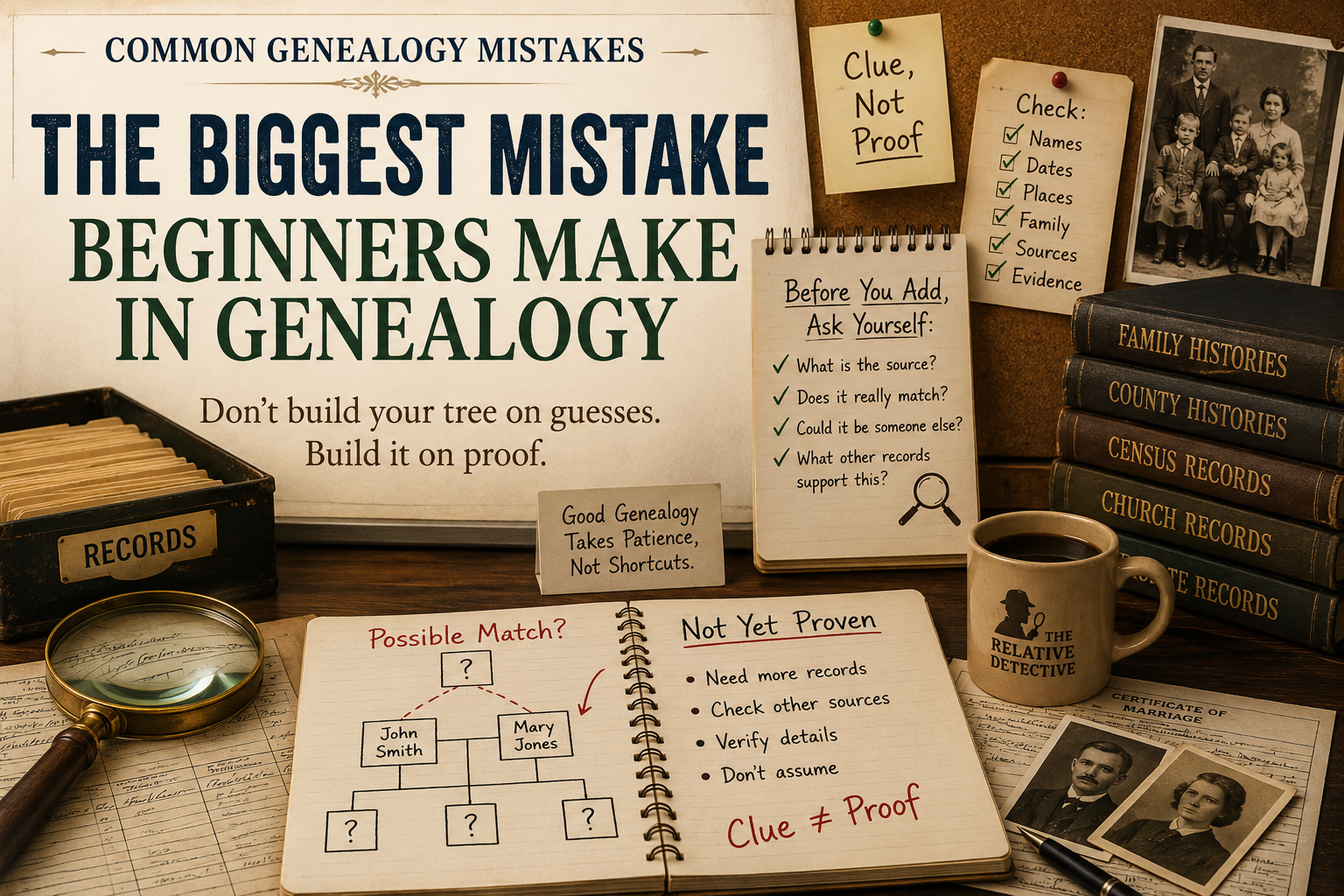
Before adding someone new to your family tree, pause and ask three questions:
- What evidence connects this person to my family?
- Does the record fit with what I already know?
- Could this be someone else with the same name?
If you can answer those questions, you are on much stronger ground.
You do not need to be perfect. You just need to be careful. Genealogy rewards patience, even if it occasionally hides the reward under bad handwriting and three different spellings of the same surname.
Final Thoughts
The biggest mistake beginners make in genealogy is adding people before proving they belong. It is easy to do, especially when hints, online trees, and matching names make a connection look tempting.
Slow down. Check the records. Compare the whole picture. Prove relationships before building the next generation.
Your family tree does not need to grow fast. It needs to grow strong. A careful tree is easier to trust, easier to fix, and much less likely to invite the wrong ancestor to Thanksgiving.