Where Did I Find That? A Beginner’s Guide to Genealogy Sources
Where Did I Find That? A Beginner’s Guide to Genealogy Sources
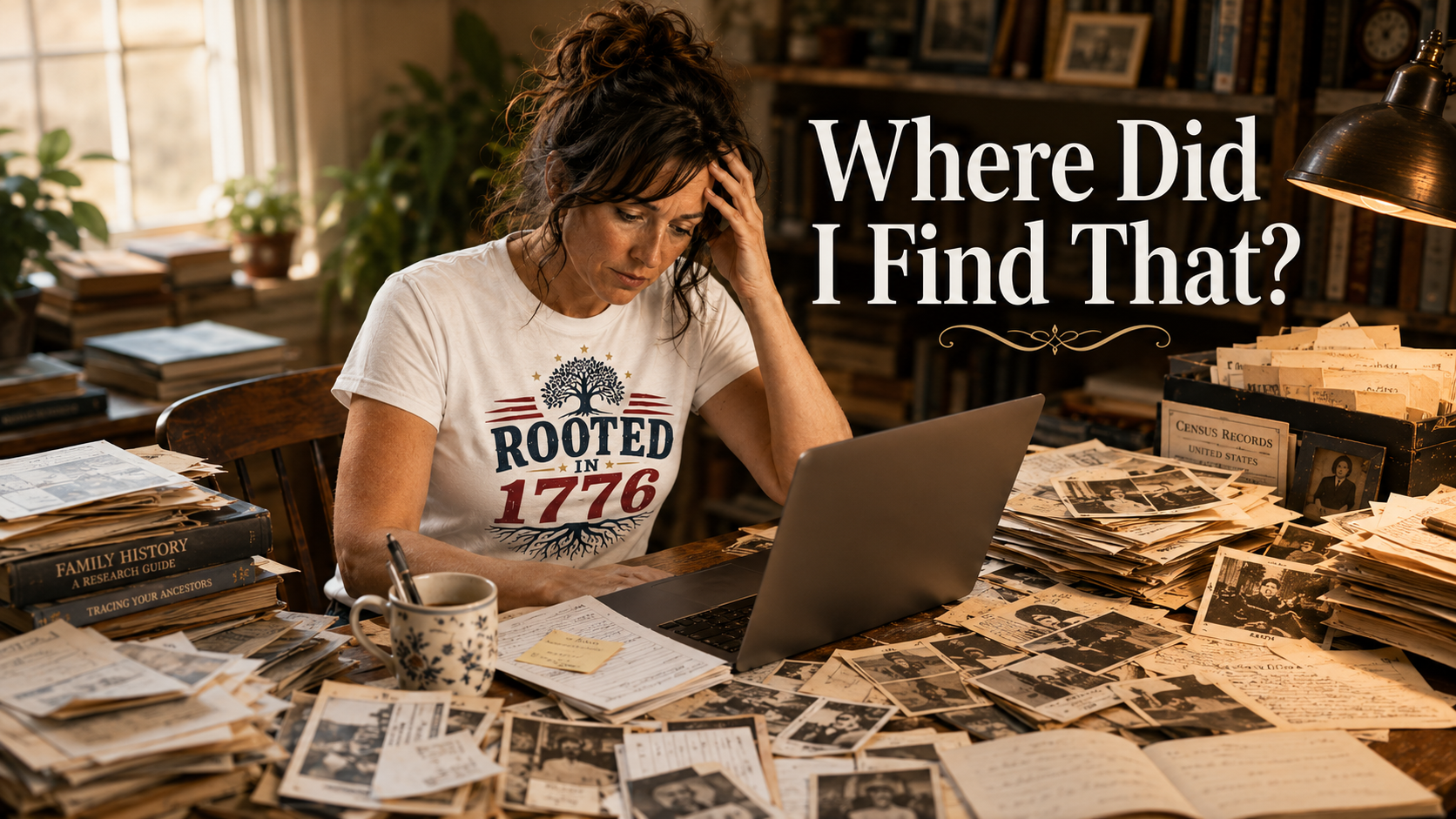
Every family researcher has had this moment.
You are looking through your family tree, feeling pretty good about your progress, when you spot a birth date, a maiden name, or a parent-child relationship and suddenly think:
Wait. Where did I find that?
You click around. You check the attached records. You search your downloads folder. You stare at the screen like the answer might rise from the mist.
Nothing.
That little fact is just sitting there in your tree with no explanation, no source, and no memory of how it got there. It may be correct. It may be a clue. It may be something you copied from another tree at 1:00 in the morning while making questionable genealogy decisions.
This is exactly why genealogy sources and research notes matter.
The good news is that you do not need to write perfect professional citations when you are just starting out. You simply need to write enough information so you can find the record again, understand what it says, and remember why you believed it mattered.
What Is a Genealogy Source?
A genealogy source is anything that gives you information about a person, family, event, place, or relationship.
Sources can include:
- Birth records
- Marriage records
- Death records
- Census records
- Church records
- Military records
- Wills and probate files
- Land records
- Newspaper articles
- Obituaries
- Gravestones
- Family Bibles
- Old letters or photographs
- Online family trees
Some sources are stronger than others, but almost any source can be useful if you label it clearly and understand what it is actually telling you.
A record can give you a clue. A group of records that agree with each other can help build a stronger conclusion.
Why You Should Write Down Your Sources
When you are researching, it is tempting to think you will remember where everything came from.
You will not.
That is not an insult. That is genealogy reality.
After a while, names repeat. Dates blur together. Families move around. Everyone names their children John, Mary, William, Sarah, and Elizabeth like they were legally required to do so.
Writing down your sources helps you:
- Find the same record again later
- Check whether a clue is reliable
- Avoid copying mistakes from other trees
- Understand why you added a fact
- Compare conflicting records
- Share your research more clearly with others
Good source notes are not about being fancy. They are about leaving a trail for yourself.
What Is a Source Note?
A source note tells you where a piece of information came from.
At a basic level, a helpful genealogy source note should answer these questions:
- What type of record was it?
- Who was named in the record?
- What place does the record cover?
- What date or year is connected to it?
- Where did you find it?
- When did you access or save it?
You do not have to make this complicated.
Here is a simple formula:
Record type, person or household name, place, date or year, website or archive, access date.
For example:
1900 U.S. Census, household of John Miller, Syracuse, Onondaga County, New York, Ancestry, accessed May 21, 2026.
That may not be a perfect professional citation, but it is useful. It tells you what you found, who it involved, where it was, and where you found it.
That is much better than writing “found online,” which is basically throwing your ancestor into a fog machine and hoping for the best.
What Is a Research Note?
A research note is different from a source note.
A source note tells you where the information came from.
A research note tells you what you think the information means.
Here is the difference:
Source note: 1880 U.S. Census, household of Thomas Brown, Albany, New York, FamilySearch, accessed May 21, 2026.
Research note: This may be the correct Thomas Brown because the age, wife’s name, and children match later records. However, the birthplace is listed as New York instead of Ireland, so more records are needed before confirming.
The source note helps you find the record again.
The research note helps you remember your reasoning.
You need both, especially when a record is confusing, incomplete, or only partly matches what you expected.
What Should You Write Down From a Record?
When you find a useful record, do not just attach it and move on.
Take a minute to write down what you learned from it.
For example, if you find a census record, your note might include:
- The person’s name
- Age or estimated birth year
- Birthplace
- Residence
- Occupation
- Other people in the household
- Nearby relatives or familiar neighbors
- Anything unusual or unexpected
Your research note does not need to be long. It just needs to capture why the record matters.
A Simple Research Note Example
Here is a beginner-friendly research note:
The 1900 U.S. Census shows John Miller living in Syracuse, New York, with wife Anna and children William, Sarah, and Joseph. His birth month is listed as March 1854, and his birthplace is listed as New York. This supports the idea that the John Miller in this household is the same John Miller later found in the 1910 census in Onondaga County.
This note is helpful because it does three things:
- It says what the record shows.
- It explains why the record matters.
- It connects the clue to a larger research question.
That is the kind of note that saves you from future confusion.
Write Down What You Are Still Unsure About
One of the best habits in genealogy is writing down what is still uncertain.
It can feel strange at first because we all want clean answers. But uncertainty is normal in family history research.
Useful notes might say:
- This may be the correct person, but I need more proof.
- The age does not match exactly.
- The name is spelled differently in this record.
- This record gives a possible parent, but I need another source.
- This family appears near known relatives, but the relationship is not proven yet.
Those notes are not failures. They are smart research.
A good researcher does not pretend every clue is proven. A good researcher keeps track of what is known, what is possible, and what still needs work.
Use Simple Labels: Clue, Likely, and Proven
If you want an easy way to organize your thinking, try using three simple labels:
- Clue: Interesting, but not proven yet.
- Likely: Supported by some evidence, but more research would help.
- Proven: Strongly supported by multiple reliable records.
Here are a few examples:
Clue: Online tree lists Margaret Wilson as the mother of James Carter, but no record is attached.
Likely: James Carter’s death record names his mother as Margaret Wilson, and the 1850 census places him in a Wilson household.
Proven: James Carter’s birth record, marriage record, and death record all support Margaret Wilson as his mother.
This keeps your tree from becoming a pile of maybes wearing fake mustaches and pretending to be facts.
Be Careful With Online Family Trees
Online family trees can be helpful, but they should usually be treated as clues unless they include solid sources.
If you use information from another tree, write that down honestly.
For example:
Online family tree on Ancestry lists Robert Green as the father of Henry Green. No supporting record was attached. Treat as a clue only.
That note protects you from accidentally turning someone else’s guess into your family history.
Public trees can point you in the right direction. They can also send you galloping confidently into the wrong century, which is exciting but not especially helpful.
Do Not Just Save the Record — Explain the Record
Attaching a record to your tree is helpful.
Explaining why you attached it is even better.
For every important source, ask yourself:
- What fact does this record support?
- Does it prove the fact directly?
- Does it only suggest the fact?
- Does it conflict with another record?
- What should I check next?
This turns your genealogy from a collection of records into actual research.
A Simple Template You Can Copy
Here is an easy research note template you can use:
Person: [Name]
Research question: [What am I trying to prove?]
Source: [Record name, place, website/archive, access date]
What the record says: [Important details]
Why it matters: [How this helps answer the question]
Confidence level: [Clue, likely, or proven]
Next step: [What should I look for next?]
You can make this as simple or detailed as you want.
The goal is not perfection. The goal is clarity.
Example Using the Template
Person: Sarah Thompson
Research question: Was Sarah Thompson the daughter of William Thompson?
Source: 1860 U.S. Census, William Thompson household, Madison County, New York, FamilySearch, accessed May 21, 2026.
What the record says: Sarah Thompson, age 12, is living in the household of William and Mary Thompson.
Why it matters: This supports a possible parent-child relationship, but the census does not directly state that Sarah is William’s daughter.
Confidence level: Likely, but not proven.
Next step: Look for Sarah’s marriage record, death record, obituary, or William’s probate file.
This is a strong note because it does not overclaim.
It says what the record shows, what it suggests, and what still needs to be checked.
Where Should You Keep Genealogy Notes?
There is no single perfect system.
You can keep notes in:
- Your Ancestry tree notes
- FamilySearch person notes
- A Google Doc
- A Word document
- A spreadsheet
- A genealogy notebook
- A digital research log
The best system is the one you will actually use.
If a fancy system makes you avoid writing notes, it is not helping you. A simple note you use every time is better than a perfect template you abandon after two days.
A Quick Beginner Checklist
Before you move on from a record, ask:
- Did I write down where I found it?
- Did I write down who was named in it?
- Did I save the date, place, and record type?
- Did I explain what the record proves or suggests?
- Did I note any problems or conflicts?
- Did I write down the next thing to search for?
If you do those things, your research will be much easier to understand later.
Final Thoughts
Writing genealogy sources and research notes does not have to be complicated.
You do not need perfect wording. You do not need to sound like a professional researcher. You do not need to spend twenty minutes building one citation while your coffee gets cold and your will to continue slowly leaves your body.
You just need to write down enough information to answer three questions:
Where did this come from?
What does it say?
Why do I think it matters?
That is the foundation of good genealogy research.
Because family tree clues are wonderful, but only if you can find your way back to them.