
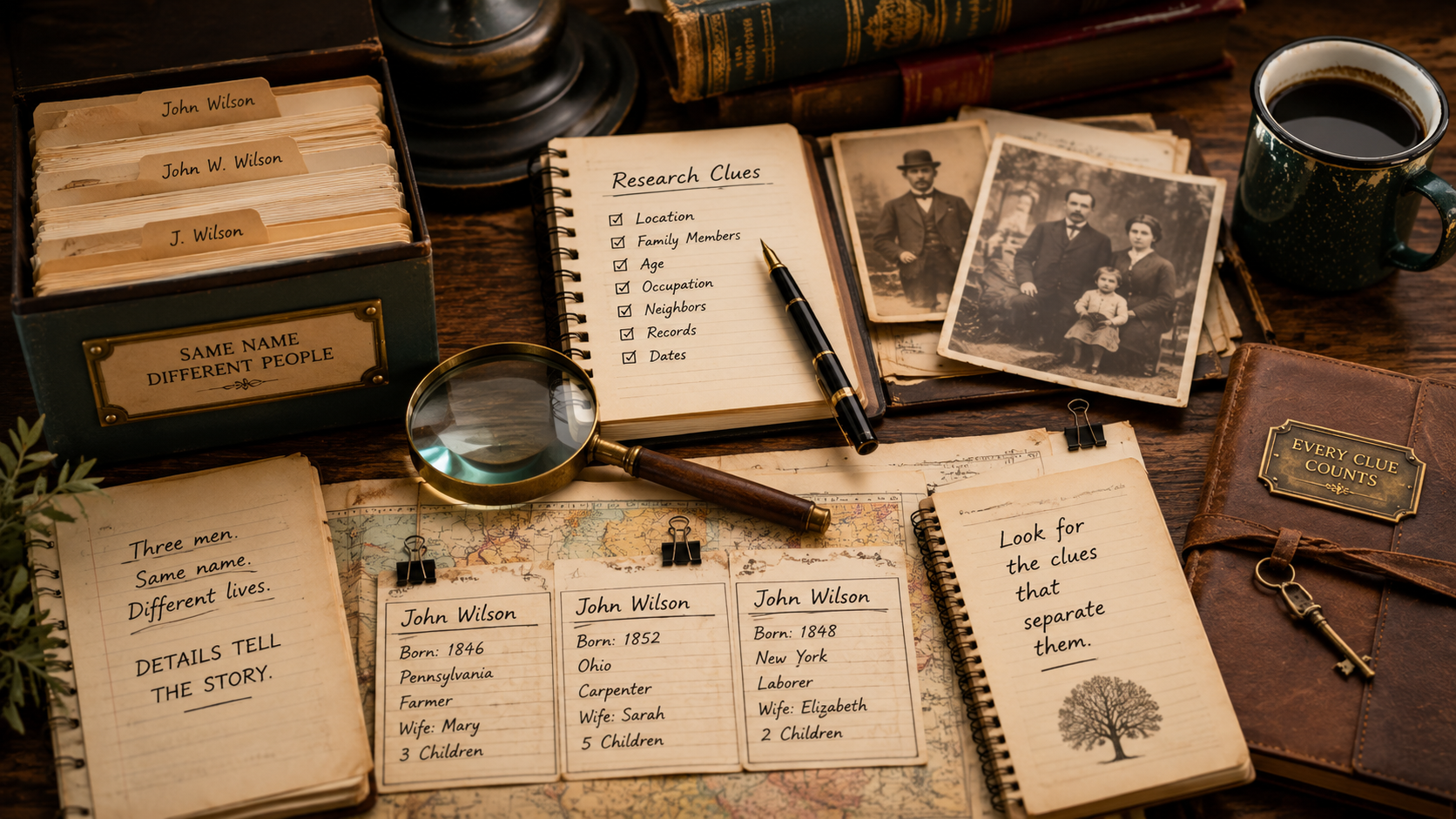
What to Do When You Find Three People With the Same Name
At some point in genealogy, it happens. You search for one ancestor and find three people with the same name, living around the same time, possibly in the same place, all looking suspiciously like they could belong in your family tree.
This is when genealogy stops feeling like a peaceful hobby and starts feeling like a detective show where every suspect is named John.
Do not panic. Finding multiple people with the same name is very common, especially with older records. The trick is to slow down, compare the details, and resist the urge to grab the first person who looks close enough.
Why Same-Name Confusion Happens
In many families and communities, the same names were used over and over. Sons were named after fathers, grandfathers, uncles, saints, neighbors, or whoever was popular in the family that decade.
That means you may find several people with the same name in one county, especially if the surname was common.
You might see:
- Two cousins with the same name
- A father and son with the same name
- Uncles and nephews with the same name
- Different families using the same first names
- People with similar ages living nearby
So if you find three William Browns, do not assume the universe is personally attacking you. It might be, but in this case it is probably just naming traditions.
Do Not Pick the First Match
When you find a record with the right name, it is tempting to accept it right away. After all, the name matches, the place is close, and you really want this branch to move forward.
But a matching name is only the beginning. It is not proof.
Before adding a record to your tree, ask:
- Is the age close?
- Is the location reasonable?
- Does the spouse match?
- Do the children match?
- Does the occupation fit?
- Are there nearby relatives?
- Does this record agree with other records?
One matching name is a clue. Several matching details are much stronger.
Create a Comparison Chart
When you are dealing with several people who have the same name, a simple comparison chart can save your sanity.
Make a list of each possible person and compare what you know.
For example:
- John Miller #1: born about 1845, wife Mary, lived in Ohio, farmer
- John Miller #2: born about 1848, wife Sarah, lived in Pennsylvania, blacksmith
- John Miller #3: born about 1846, unmarried, living with parents in New York
Once you lay the details side by side, the differences often become much easier to see.
You do not need anything fancy. A notebook page, spreadsheet, or document works fine. The goal is to stop all the same-name people from blending together into one giant genealogy soup.
Use the Whole Household
One of the best ways to tell same-name people apart is to look at the whole household, not just the ancestor you are searching for.
Census records are especially helpful for this.
Look at:
- Spouse’s name
- Children’s names and ages
- Other relatives in the home
- Neighbors
- Birthplaces
- Occupation
If your ancestor was married to Catherine and had children named Anna and Joseph, be careful with a census record for a man with the same name who is married to Elizabeth with children named Samuel and Grace.
It could be a different family. Or your ancestor had a much more complicated life than expected. Either way, do not assume.
Pay Attention to Location
Location matters. People did move, but most did not teleport from county to county every time a record was created.
When comparing same-name people, ask:
- Where was this person living?
- Is that close to the known family location?
- Did the family have a reason to move?
- Do records show them in the same area before and after?
- Are relatives nearby?
If one record places your ancestor in New York in June and another places a same-name person in Georgia with a different family the same year, those are probably two different people.
Genealogy does involve surprises, but we should not make our ancestors sprint across the country without evidence.
Build a Timeline
A timeline is one of the best tools for sorting out people with the same name.
Write down every record you find in date order. Include the person’s age, location, spouse, children, occupation, and any other helpful details.
Your timeline might look like this:
- 1870: John Miller, age 25, living in Erie County, New York with parents William and Anna
- 1875: John Miller marries Mary Thompson in Erie County
- 1880: John Miller, age 35, living with wife Mary and children Anna and Robert in Ohio
- 1900: John Miller, born May 1845, living in Ohio with Mary
A timeline helps you see whether the records fit together logically. It also helps you spot records that belong to someone else.
Look for Middle Names and Initials
Middle names and initials can help separate same-name people, but use them carefully.
One record may list a person as John Miller. Another may list him as John A. Miller. Another may say J. A. Miller. These could be the same person, or they could be different people.
Watch for:
- Middle initials
- Nicknames
- Full middle names
- Jr. or Sr.
- Suffixes like II or III
But remember, Jr. and Sr. did not always mean father and son in older records. Sometimes they were used to tell apart two men with the same name in the same community.
Because apparently genealogy was not already confusing enough.
Check Occupations
Occupations can be useful clues. If your ancestor is listed as a farmer in several records, and another same-name person is consistently listed as a blacksmith, that may help you separate them.
Occupations can change, of course. A person might farm for a while, work in a mill later, or take another job after moving.
But when paired with age, location, spouse, and children, occupation can help build a stronger picture.
Use Records Beyond the Census
Census records are helpful, but they are not the only records you should use. When same-name people are causing trouble, look for other records that can connect the dots.
Helpful records may include:
- Marriage records
- Death certificates
- Obituaries
- Church records
- Land records
- Probate records
- Military records
- City directories
- Newspapers
A probate record may name children. An obituary may name siblings. A marriage record may name parents. A land record may place someone in a specific county at a specific time.
The more records you compare, the easier it becomes to tell which person is yours.
Keep a “Not My Person” Note
When you rule someone out, write it down.
This may sound unnecessary, but it can save you from checking the same wrong person again later. Same-name people have a way of wandering back into your research like they forgot they were already dismissed.
A simple note might say:
This John Miller is not the same person as my John Miller. He was married to Sarah, lived in Pennsylvania, and had different children.
That note protects your research and saves future-you from having the same argument with the same wrong John.
Do Not Be Afraid to Leave It Unsolved
Sometimes you will not be able to tell right away which person is yours. That is okay.
It is better to leave a question open than to attach the wrong person to your tree. You can always come back later when you find more records.
Use words like:
- Possibly
- Likely
- Needs more research
- Not yet confirmed
This keeps your tree honest. Genealogy does not punish you for uncertainty. It punishes you for pretending uncertainty is proof, usually by creating a mess three generations wide.
Final Thoughts
Finding three people with the same name can be frustrating, but it is also a normal part of genealogy. The key is to compare details carefully instead of choosing the first match that looks close.
Use the whole household, track locations, build a timeline, compare occupations, and check multiple record types. Keep notes on people you rule out, and do not be afraid to leave a question open until you have better evidence.
Same-name ancestors can be tricky, but they are not unbeatable. Take it one clue at a time, and eventually the right person usually starts waving from the paperwork. Sometimes quietly. Sometimes from behind three other John Millers.